Table of Contents
Introduction: Why AI Agents Matter
Artificial Intelligence has always promised transformation, but 2025 marks a decisive shift. After years of experimenting with generative systems, businesses are now embracing AI Agents — autonomous digital employees capable of completing entire workflows end-to-end.
This shift is more than technological—it’s a cognitive industrial revolution. Instead of humans manually performing repetitive work, autonomous systems now handle execution while people focus on creativity, strategy, and decision-making.
Generative AI democratized creation.
AI Agents democratize execution.
From Generative AI to AI Agents
Generative AI dominated 2023–2024 with content creation. But these models were passive—they waited for prompts and had limited memory.
AI Agents, however, are active and autonomous. They:
- Observe digital environments
- Reason through multi-step tasks
- Use tools and APIs
- Self-correct
- Complete tasks without supervision
Example:
A generative model drafts an email.
An AI Agent drafts it, checks schedules, sends invites, and updates CRM entries—autonomously.
Architecture of Autonomous Systems
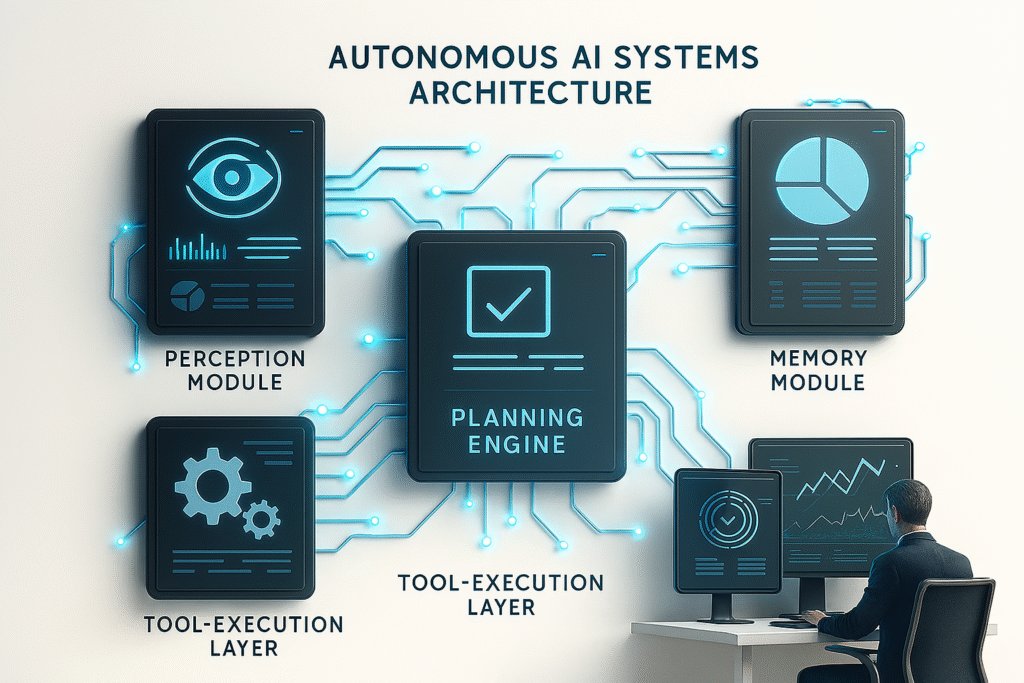
Modern AI Agents rely on four core pillars:
1. Perception & Context
Parsing files, browsing interfaces, interpreting dashboards, reading emails.
2. Memory & Persistence
Retaining long-term project state and preferences—true continuity.
3. Planning & Reasoning
Breaking down complex tasks into steps and correcting errors along the way.
4. Tool Use & Execution
Triggering APIs, executing code, sending emails, updating documents.
External Resource (DoFollow):
OpenAI Research on advanced reasoning
The New Digital Workforce
Autonomous digital employees are reshaping industries:
Autonomous digital employees are already reshaping industries:
- Sales: Lead scoring, outreach, CRM updates
- Legal: Contract analysis, research (e.g., Harvey AI)
- Marketing: Campaign automation, SEO research, trend monitoring
- HR: Resume parsing, interview scheduling, candidate screening
- Customer Service: Instant resolutions (e.g., Klarna’s AI system handled two-thirds of customer chats)
Internal link suggestion:
Link to your post: AI Stock Tools: 10 Powerful Platforms That Actually Make You Money – Prompt Forge
Economics of AI Agents
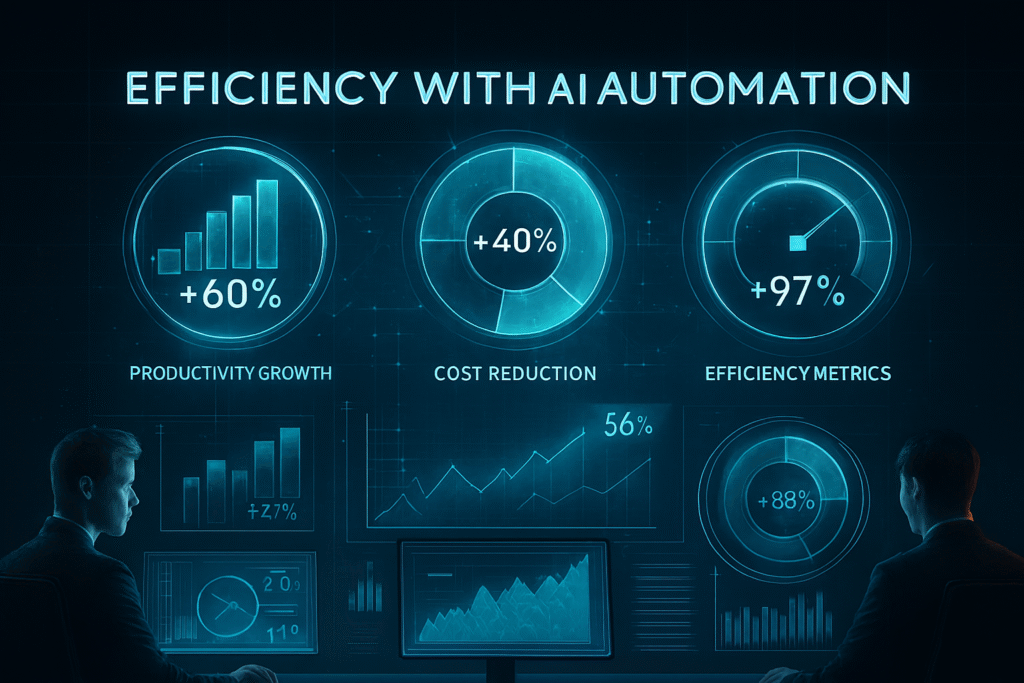
Organizations are adopting autonomous systems because the economic impact is undeniable:
- 88% faster task completion
- 90–96% cost reduction
- 1000x cheaper customer support interactions
- Writing tasks: 40% faster
- Coding tasks: 55.8% faster
- Consulting: 25% faster
However, hallucinations and flawed assumptions remain risks—so human oversight is essential.
The winning model is hybrid orchestration: humans managing AI workflows.
A Day in the Life with AI Agents
Imagine Alex, a product manager in 2025:
- Morning emails triaged by an Inbox Agent.
- Meeting notes transcribed and turned into Jira tickets by a Scribe Agent.
- Competitor research compiled into charts by a Research Agent.
- Calendar conflicts resolved by a Personal Assistant Agent.
Alex’s role isn’t typing faster—it’s orchestrating AI workflows and making strategic decisions.
Human Impact & Skill Shifts
Agentic AI reshapes career priorities.
↓ Skills Losing Value
- Data entry
- Basic coding
- Repetitive documentation
↑ Skills Increasing in Value
- Workflow design
- Strategic reasoning
- Negotiation
- Judgment in ambiguity
Success depends on “agent literacy”—the ability to work with and orchestrate digital coworkers.
Challenges in Deploying AI Agents
Despite the hype, adoption isn’t frictionless:
- Reliability & trust: Systems may loop, lose context, or hallucinate.
- Security risks: Identity management for autonomous systems is still evolving.
- Adoption gap: Many pilots stall before reaching production due to governance concerns.
The Roadmap for AI Agents
The future of AI Agents is clear:
- Superagency model: One human managing multiple agents.
- Multi‑agent systems: Swarms collaborating on complex goals.
- Invisible integration: Agents embedded in Microsoft 365 and Google Workspace.
- Machine‑to‑machine SEO: Agents optimizing content not just for humans, but for other agents searching the web.
Google DeepMind on Multi-Agent Collaboration
Conclusion: The Agentic Age
We’ve entered the Agentic Age—a cognitive industrial revolution where autonomous systems handle execution and humans focus on creativity.
Leaders must:
- Deploy AI where risks are manageable
- Train teams in agent literacy
- Build governance frameworks before scaling
AI Agents aren’t just tools—they are digital colleagues transforming the nature of work.